ANTI-TELEGRAPH POLES PROTESTERS have stepped up their activities this week in response to several key developments.
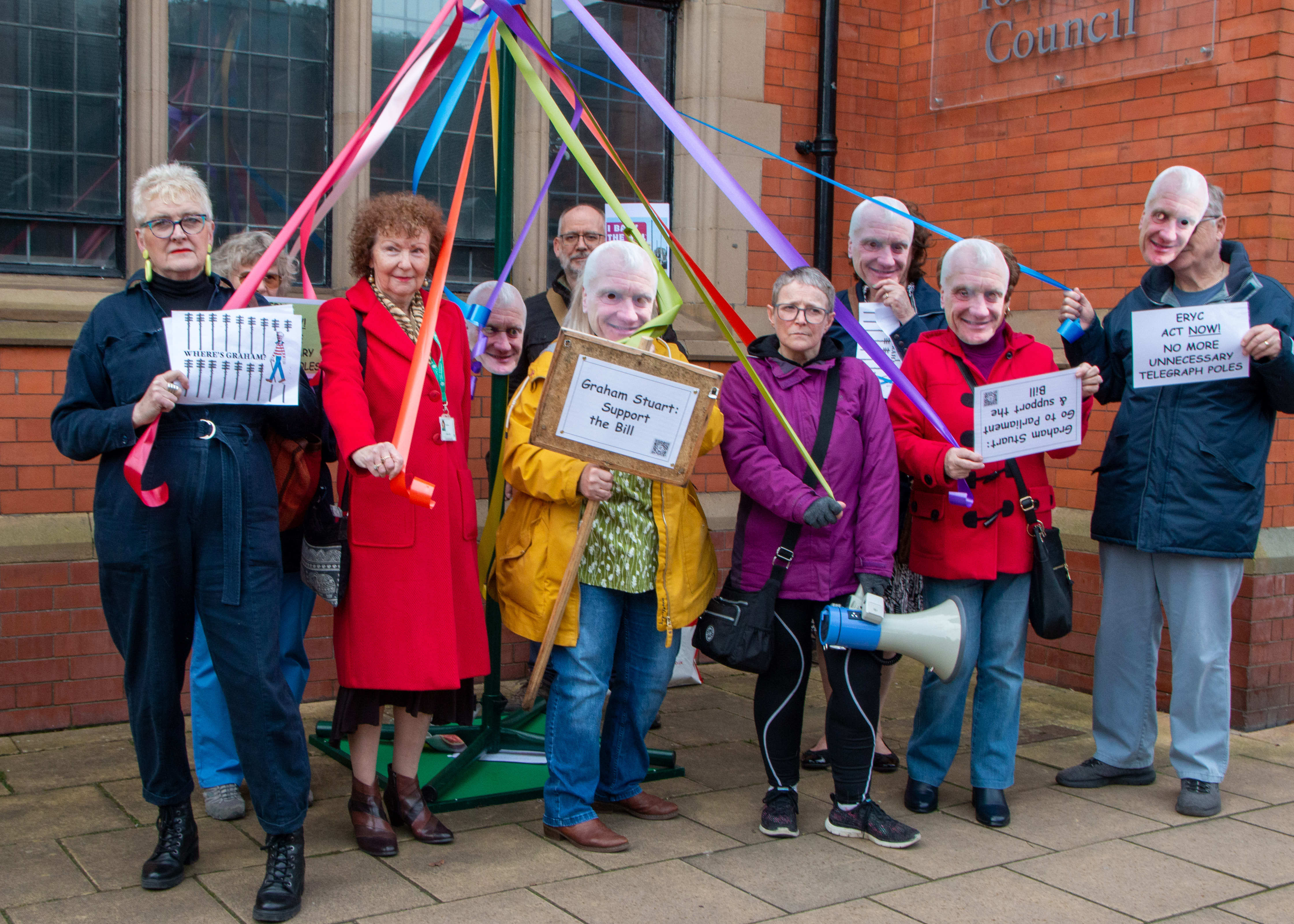
Following the expectation that Dame Diana Johnson’s private member’s bill would be discussed in Parliament on Friday 15 March 2024, a lobby was held outside Graham Stuart’s constituency Conservative Party office in Beverley on Thursday, encouraging the MP to support the bill. It was attended by about 40 people including several East Riding councillors and campaigners from across the county including Going Underground supporters from Hedon. Some wore Graham Stuart masks jokingly to say “Where’s Graham?” i.e. not in Parliament to support the Johnson bill, and not here in support of the national petition!

Sadly, the disappointing message was received during the lobby event that the Johnson bill would not be airing in Parliament after all – it had been timed out of the agenda. Campaigners expressed their frustration at the government and parliamentary lack of action and response. They are being passed from one Government department to another, to Ofcom to the council and back round again. “MPs might be having a roundtable event, but campaigners seemed to have been led onto a Merry-Go-Round!” complained one protester. A May Pole was taken to the lobby to demonstrate that idea.


A ‘roundtable event‘ for MPs concerned about the distress caused to communities because of telecommunication installations has been called for March 25 according to Minister for Data and Digital Infrastructure Julia Lopez MP. The Going Underground group has written to the Minister and copied Graham Stuart with suggestions to what should be included on the agenda. Going Underground’s Joyce Whittle presented the MP with his copy of the letter at his street surgery in Beverley on Saturday.
Text of letter to Minister Lopez
Dear Minister,
Roundtable meeting on the impact of telecommunications installations on
communities.
We note that as Minister of State for Data and Digital Infrastructure you
intend to convene a roundtable discussion on 25 March 2024 of concerned
MPs regarding the community distress caused by the rollout of
telecommunications infrastructure. One of the aims is to to get a better sense
of how geographically widespread this issue is.
Campaigners against unwanted and unnecessary telecommunications
infrastucture are obviously very interested in the discussions that are taking
place at the roundtable event and of course its outcomes. We would
appreciate knowing when and where this event is taking place and whether it
will be screened live or recorded.
We particuarly feel that the following matters should be included as subjects
at the roundtable:
- Urgent advice needs to be issued to local planning authorities on how to
manage their relations with code operators or alternative network builders
(AltNets). Councils need to be confident in the powers they have at their
disposal to protect the interests of residents and the local environment. They
need to understand the powers available to curtail the actions of AltNets and
especially the “bad actors” and those engaging in poor practice. The access
of councils to Ofcom to report AltNets as “bad actors” should be eased
prompting speedier investigations. - Community engagement needs to be built into the process. AltNets need to
respect the expressed wishes of communities when, following due
consultation, they say no to alternative and new infrastructure. - Where the expressed legitimate wishes of a community have been ignored,
and poles deployed anyway, they should be removed. - In light of the Minister’s letter of 14 March to fixed-line operators and the
renewed emphasis on infrastructure sharing, then the proliferation of
telegraph poles and other additional infrastructure needs to be curtailed. The
use of telegraph poles should cease in areas where existing gigabit capable
infrastructure exists underground and where existing incumbent telegraph
poles can be used. The reality of two, three or four alternative network
builders deploying sets of poles down the same streets is an unintended
consequence of permitted development and should end straight away. Where
an overbuild has occurred, then discussion on removing poles and creating
one shared network should take place. - Could the minister advise if the legal protection for scheduled monuments
has been forfeited in the UK under permitted development? Scheduled
monuments are not always visible and so protection may be missed and
heritage land planted with telegraph poles. The roundtable event should be an
opportunity to discover if this is an issue nationwide. - Parliament and the Minister should facilitate a national roundtable event of
community campaigns opposed to new infrastructure to really understand
the issues in local communities. Community opposition is not a barrier to be
busted, rather an opportunity for more meaningful engagement. - Your letter to fixed-line operators suggests the legislative framework is not
robust enough to deter poor practice, will the Minister seek to urgently amend
it? And should the revised Code of Practice be made mandatory?

Ofcom has reportedly replied to the East Riding Council saying that its powers are limited in acting against code operators (poles companies) and that it will not conduct an emergency review into broadband companies in the East Riding, or stop current works. This is nothing new from the telecommunications regulator – they have been saying this consistently since the East Riding campaign began in September. However, after hinting for nearly twelve months that councils had powers to act against errant companies, it is hoped Minister Lopez, in her latest round of meetings with the regulator, can address this issue and give Ofcom the teeth it needs to tackle ‘bad actors’ and advise local councils accordingly.
(Ongoing)
We need positive outcomes from the meeting between Minister Julia Lopez and OFCOM .
OFCOM need the powers to stop unnecessary and multiple infrastructures where they are not required to provide gigabit capable broadband .
We Welcome choice of ISPs but they should be made to share infrastructure or go underground.
OFCOM need powers to regulate without waiting for the bad practitioners to report one another
Regulation and a mandatory code of practise is essential to make sure bad practitioners stop their bad practices across the UK .
The installation of multiple infrastructure and predominantly telegraph poles in places is not required and definitely not wanted , it is an assault on our streets.
Government need to revoke permitted development rights for telecommunications installations knowing as it does , removing planning department involvement and public consultation has blighted our streets in many areas .
Hull and cottingham having triplicate overground infrastructure in many areas , duplicate in newer areas .Hedon duplicate but not safe from further infrastructure
If not a revoke an amendment to state where gigabit infrastructure is in place all fixed line operators must share that infrastructure , however this may not protect our scheduled monuments and other areas of significant interest as happened in Hedon again due to bad practise
We hope the meeting on the 25/3 between Julia Lopez and MPs will leave the minister with no doubts that change to legislation to protect OUR villages , towns and cities is essential . Also that ofcom , local authorities will have the powers to abate bad practise from code operators and that the minister will take action as she has stated in her letter to fixed line operators if they do not share infrastructure.